Comparison
Yanagiba vs Sujihiki: The Slicing Knife Decision Guide
Published: 2026-04-29 · Updated: 2026-04-29
I’ve owned a yanagiba for almost six years now, and a sujihiki for four. They sit next to each other in my knife drawer, and people always ask me the same question: “Aren’t they basically the same knife?” The short answer is no. The longer answer is that they look similar — both long, slim, single-purpose slicers — but they’re built for fundamentally different jobs, and using the wrong one will frustrate you.
If you’ve been staring at knife shop listings trying to figure out which long, skinny blade you actually need, this guide should clear it up. I’ll cover what each knife is, who it’s for, what I learned the hard way, and which ones I’d recommend at different budgets.
The 30-second version
A yanagiba is a traditional Japanese single-bevel slicing knife designed almost exclusively for raw fish — sashimi, sushi, nigiri toppings. The single-bevel geometry produces glass-smooth slices that don’t bruise delicate flesh. It’s also the harder knife to learn, sharpen, and maintain.
A sujihiki is a double-bevel Western-style slicer. Think of it as a Japanese take on a carving knife or roast slicer. It handles brisket, prime rib, ham, salmon sides, and yes — fish — with far less learning curve. It’s ambidextrous, easier to sharpen, and more versatile.
If you slice raw fish for sashimi seriously and often, get a yanagiba. If you mostly slice cooked proteins and want something for fish too, get a sujihiki. Most home cooks should get a sujihiki.
What is a yanagiba?
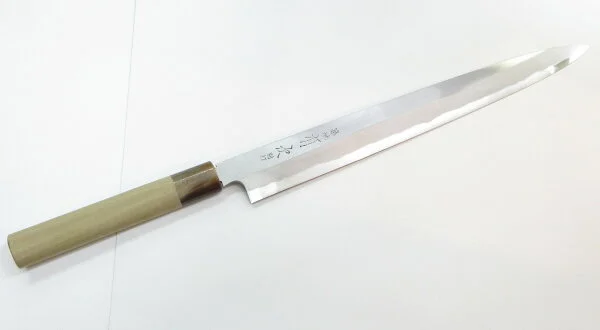
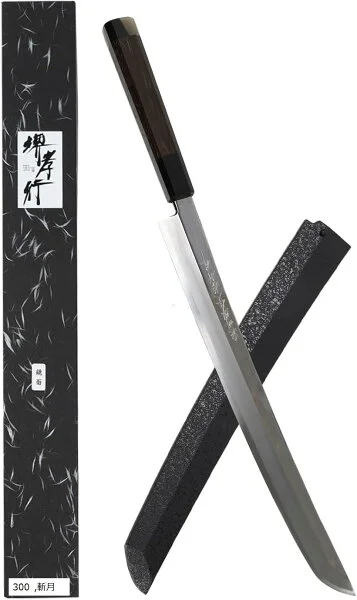
The word means “willow blade,” which is exactly what it looks like: long, narrow, gently curved like a willow leaf. Lengths run from 240mm at the short end to 330mm for professional sushi chefs.
The defining feature is the single bevel. The right side (for right-handed users) has the cutting edge ground at an angle around 10–15 degrees. The left side is flat — actually concave, with a hollow ground area called the urasuki — and meets the bevel at the apex. This geometry does two things:
- Almost no friction on the food side. The flat back glides past the slice without dragging.
- Steers the blade toward the bevel side. This is also its biggest drawback for beginners.
The intended cutting motion is a single pull stroke — the hiki-zukuri or sogi-zukuri draw — using as much of the blade as possible in one motion. No sawing, no push, no chop. That’s why yanagiba are so long: a 270mm blade lets you take a clean tuna slice in one pull without ever lifting the knife mid-cut.
Yanagiba are usually made from carbon steel — Shirogami (white) #2 or Aogami (blue) #2 are traditional, with Ginsan (silver-3) stainless as a more forgiving modern option. They’re often hand-forged in Sakai by specialist makers, with prices starting around $180 and reaching well over $1,000 for premium honyaki versions.
What is a sujihiki?
Suji means sinew or tendon, hiki means to pull. So literally, “sinew slicer.” It evolved as a Japanese version of the Western carving knife — long, narrow, double-beveled, designed for separating cooked meat from connective tissue and producing thin even slices off a roast.
Lengths typically run 240–300mm, with 270mm being the sweet spot for home use. The blade is much narrower than a gyuto (an inch shorter in height, usually) which keeps friction low when slicing through dense meat. Tip is pointed, profile is mostly straight with a gentle curve toward the tip.
Because it’s double-beveled, a sujihiki:
- Cuts straight without steering
- Works for left or right hand
- Is sharpened on a whetstone the same way you’d sharpen a gyuto
- Handles cooked meat, fish, ham, smoked salmon, brisket, prime rib, turkey, pork loin
Steel options are wide open. You’ll find sujihiki in everything from VG-10 stainless ($120) to Aogami Super clad in stainless ($250) to powdered steels like SG2 or R2 ($300+). Far more variety than yanagiba.
Single-bevel vs double-bevel geometry
This is the core difference, and it shapes everything else. Imagine looking at the knife from the tip end:
- A yanagiba has a chisel-like edge — one side angled, one side flat. When you push it through food, the angled side wedges material upward and the flat side stays clean. The slice releases in a single thin sheet.
- A sujihiki has a symmetrical V-shaped edge with bevels on both sides. It cuts straight down without preferring either side.
The single-bevel edge can be ground at a much shallower angle than a double-bevel — sometimes under 10 degrees per side. That’s why a sharp yanagiba feels almost effortless on raw tuna. But that thin edge is fragile. Hit a bone or a frozen edge and you’ll chip it.
Double-bevel edges on a sujihiki sit around 12–15 degrees per side. Less acute, more durable, less specialized. The edge survives accidental contact with bones in salmon, brisket fat caps, or a slightly tough turkey.
Intended uses (where they actually shine)
Yanagiba excels at:
- Sashimi cuts (tuna, salmon, hamachi, kanpachi)
- Nigiri toppings sliced to exact thickness
- Whole fish breakdown after the deba does the rough work
- Any raw protein where slice cleanliness matters
Yanagiba struggles with:
- Cooked meat (the flat side has nothing to push fibers off cleanly)
- Anything with bones
- Citrus, vegetables, bread
- Left-handed users (you need a left-handed version, which costs more and has lower selection)
Sujihiki excels at:
- Brisket, prime rib, pork shoulder
- Hot smoked or cured salmon sides
- Roast turkey, ham, leg of lamb
- Sashimi, if you don’t already have a yanagiba (it’s competent here)
- Trimming silver skin from tenderloins
Sujihiki struggles with:
- Tall vegetables (the narrow blade isn’t ideal for board-clearance work)
- Hard squash, frozen anything
- Bone-in cuts (use a different knife)
Learning curve
I’ll be honest. The yanagiba humbled me. For the first three months I owned mine, my sashimi looked like it had been gnawed by a raccoon. The single-bevel geometry pulls the blade toward the flat side as you draw it through fish — beginners overcorrect, oversteer, and end up with wedge-shaped slices instead of clean rectangles.
You also need to nail the angle of the blade against the fish, the speed of the pull, and the pressure (almost none). Watch a sushi chef for ten seconds and you’ll see the motion is closer to letting the knife fall than pushing it.
The sujihiki, by contrast, was immediately useful. If you can use a chef’s knife, you can use a sujihiki. Long pull stroke, gentle pressure, done. There’s still skill involved in getting paper-thin slices, but the geometry isn’t fighting you.
Verdict: Plan on six to twelve months to get good with a yanagiba. The sujihiki you’ll be slicing brisket like a pro within a weekend.
Sharpening complexity
Sharpening is where the yanagiba’s specialness gets expensive in time. Single-bevel knives need:
- The bevel side ground on stones from coarse to fine (the actual edge work)
- The flat back side polished — never abraded, just deburred — on a high-grit stone
- Maintenance of the urasuki (concave back) so it doesn’t flatten over years of polishing
If you mess up the back side and grind it down too much, you’ll lose the urasuki and the knife’s geometry is compromised. Many home cooks send their yanagiba out to professional sharpeners once or twice a year rather than risk it.
Sujihiki sharpening is the same as any double-bevel knife — work both sides at a consistent angle, raise a burr, deburr. If you’ve sharpened a gyuto, you’ve sharpened a sujihiki. There’s nothing weird about it.
I cover the basics in my whetstone sharpening guide and there’s a separate piece on choosing whetstones if you’re starting from scratch.
Length recommendations
For yanagiba:
- 240mm — apartment kitchens, small fish, beginners. Works but feels short.
- 270mm — the sweet spot for home cooks who do sashimi seriously
- 300mm — what most pros use. Better for whole side of salmon, large tuna loins
- 330mm — pro/restaurant only
For sujihiki:
- 240mm — fine for thinner roasts, smaller hams
- 270mm — best all-around. Handles everything I throw at it
- 300mm — go this long if you do whole brisket regularly
Counter space matters. Below 270mm you’re sacrificing single-stroke slicing, which is the whole point of these knives.
Comparison table
| Yanagiba | Sujihiki | |
|---|---|---|
| Bevel | Single (one-sided) | Double (V-edge) |
| Origin | Traditional Japanese (Kansai) | Japanese take on Western slicer |
| Primary use | Raw fish, sashimi | Cooked meat, BBQ, also fish |
| Edge angle | 10–15° single side | 12–15° per side (24–30° total) |
| Learning curve | Steep (months) | Gentle (days) |
| Sharpening | Specialist skill | Standard double-bevel |
| Lefty options | Limited, premium-priced | Any knife works either hand |
| Versatility | Low (one job) | Medium (many proteins) |
| Best length (home) | 270mm | 270mm |
| Entry price | ~$180 | ~$120 |
| Premium ceiling | $1,500+ | $600+ |
| Steel availability | Mostly carbon | Carbon and stainless both common |
Top picks at each level
I’m only listing knives I’ve personally handled or that come with strong reputations among makers I trust.
Yanagiba
Entry ($180–$280): Sakai Takayuki Ginsan 270mm. Stainless single-bevel, much more forgiving than carbon for a first yanagiba. Sakai-made, traditional construction, won’t rust if you blink.
Mid ($350–$600): Aritsugu A-type 300mm in white #2. Aritsugu is one of Tsukiji’s legendary makers; their A-type is a workhorse with a long, beautiful blade and that classic Sakai feel.
Premium ($800+): Masamoto Sohonten 270mm in white #2. Masamoto is the standard against which all yanagiba are measured. If you do this for a living, you eventually own one.
Sujihiki
Entry ($120–$180): Tojiro DP 270mm. VG-10 stainless, plain Western handle, takes a great edge, won’t rust. Ideal first sujihiki.
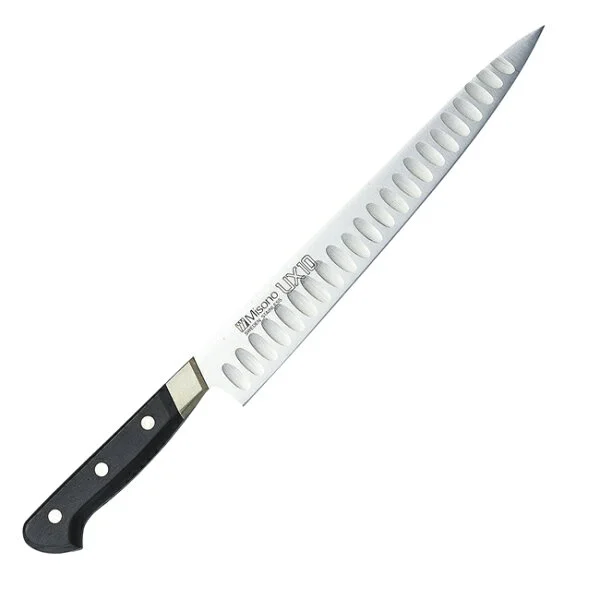
Mid ($220–$350): Misono UX10 270mm. Probably the best balance of build quality, edge retention, and price in the category. I’ve owned one for four years and it’s still my daily slicer.
Premium ($400–$700): Sakai Takayuki Aogami Super or any Yoshimi Kato R2 sujihiki. Both will outperform anything a home cook needs and will last decades.
What I’d actually buy
If I were starting over today and could only buy one slicer, it’d be a 270mm Misono UX10 sujihiki. It does 90% of what a yanagiba does plus all the cooked-meat work a yanagiba can’t touch. For most home cooks, the yanagiba is a luxury second knife, not a first slicer.
But if sashimi is the reason you’re in Japanese knives in the first place — if you’re buying whole tuna loin from H Mart or breaking down salmon sides for sushi nights — the yanagiba is non-negotiable. There’s no substitute for that single-bevel cleanliness on raw fish, and you’ll know within the first slice why people obsess over them.
Honest downsides
Yanagiba downsides I rarely see written up:
- The learning curve is real. Expect frustration.
- Carbon steel reacts with fish acids — you’ll get patina fast, and if you neglect drying you’ll get rust.
- Pro sharpening costs $40–$80 per session if you don’t learn yourself.
- Lefty pricing is brutal. Often 30% premium for limited models.
- They take counter space (300mm is a foot of blade plus handle).
Sujihiki downsides:
- Less of a “specialty knife” feeling. Some buyers want the romance.
- Narrow blade isn’t great for vegetables — don’t think of it as a second gyuto.
- Easy to under-buy on length. 240mm feels short fast.
- Mid-tier sujihiki are crowded; lots of mediocre options around $150 that aren’t worth it.
FAQ
Can I use a sujihiki for sashimi? Yes, and competently. It won’t produce the same single-stroke perfection as a yanagiba, but a sharp sujihiki on tuna or salmon will give you slices you’d be proud to serve. I did this for two years before buying my yanagiba.
Can I use a yanagiba on cooked meat? You can, but you shouldn’t. The single-bevel pulls the blade in cooked fibers and the long flat back doesn’t release the slice cleanly. You’ll fight it. Worse, hot meat juice plus carbon steel is bad for the edge.
Which is more useful for a home cook? Sujihiki, almost always. It covers more cooking situations. The yanagiba only earns its drawer space if you make sashimi at home regularly.
Are there left-handed yanagiba? Yes, but they cost more and have lower selection. Most makers offer lefty versions but with multi-week lead times. Plan ahead. Sujihiki has no lefty/righty distinction.
Do I need a deba too if I get a yanagiba? For whole-fish breakdown, yes — you need something to handle bones and the spine. But if you’re buying pre-cut fish loins and only slicing, a yanagiba alone is fine.
What’s the difference between a yanagiba and a takobiki? Takobiki is the Kanto-region version of the yanagiba. Square tip instead of pointed, slightly different profile. Functionally near-identical for sashimi work. Yanagiba is more common outside Japan.
Can I sharpen a yanagiba on the same stones as my gyuto? Yes. You’ll want a finishing stone (#5000–#8000) for the edge, but the basic stones in any whetstone kit work. The technique differs more than the stones.
What about a sashimi knife from Misono or Tojiro that’s labeled “double-bevel yanagiba”? Those are basically sujihiki marketed as “western yanagiba.” If it’s double-beveled, it’s a sujihiki regardless of the label. Treat it as such.
Where this fits in your kit
If you’re newer to Japanese knives and not sure where slicers fit at all, start with my Japanese knife buying guide for the broader picture. The steel guide helps you understand carbon vs stainless tradeoffs that matter a lot for yanagiba. And if you’re still picking your everyday knife, gyuto vs santoku is probably more relevant before you spend money on a slicer.
For sushi specifically, my sushi knife guide covers the full traditional kit (yanagiba, deba, usuba) and how they work together.
The right answer between yanagiba and sujihiki isn’t really an either/or. It’s: which one earns its place in your kitchen first. For 80% of home cooks, that’s the sujihiki. For the 20% who are obsessed with raw fish, the yanagiba is worth the climb.
🔪 この記事で紹介した包丁