Guide
How to Choose Your First Japanese Knife: A Beginner's Complete Guide
Published: 2026-04-06 · Updated: 2026-04-06
Buying your first Japanese knife is exciting, but the sheer number of options can be overwhelming. Steel types, blade profiles, handle shapes, and wildly different price points make the decision feel complicated. This guide cuts through the noise and helps you find the right knife for your kitchen, your cooking style, and your budget.
Why Japanese Knives Are Different
Japanese kitchen knives differ from their Western counterparts in three fundamental ways. First, they use harder steel, typically 58-67 HRC compared to the 54-58 HRC range found in German knives. This allows a thinner blade geometry and a more acute edge angle, usually 15 degrees per side versus 20 degrees on Western knives.
The result is a noticeably sharper, lighter, and more precise cutting tool. Ingredients glide apart rather than being forced through. Thin slices of tomato, paper-thin onion rings, and delicate herb chiffonade become effortless.
The trade-off is that harder steel can be more brittle. Japanese knives are not designed for hacking through bones, frozen food, or hard squash. Treat them as precision instruments and they will reward you for years.
Choosing Your Blade Type: Gyuto vs Santoku
For a first Japanese knife, the decision almost always comes down to two shapes.
Gyuto (Chef’s Knife)
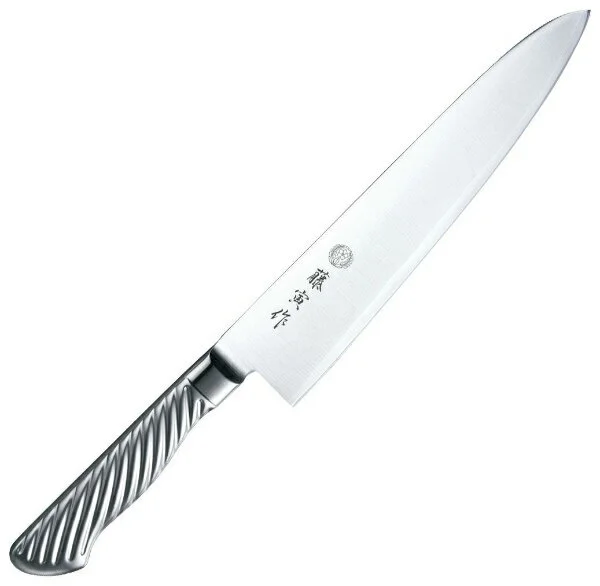
The gyuto is the Japanese equivalent of a Western chef’s knife. With a curved belly and a pointed tip, it handles everything from rocking-chop mincing to precise tip work. The 210mm length is the standard starting point. If you already use a Western chef’s knife comfortably, the gyuto will feel natural.
Santoku (Three Virtues)
The santoku features a flatter profile and a shorter blade, typically 165-180mm. It excels at the up-and-down chopping motion and is well suited to smaller hands or compact cutting boards. Many home cooks in Japan reach for a santoku as their primary knife.
Our recommendation: If you cook a wide variety of dishes and want maximum versatility, start with a 210mm gyuto. If you mostly prep vegetables and prefer a lighter, shorter blade, the santoku is an excellent choice.
Steel Types Simplified
Stainless Steel (VG-10, AUS-10, Ginsan)
The best choice for beginners. Stainless knives resist rust, require minimal maintenance, and can go through a normal wash-and-dry routine without worry. VG-10 is the most popular stainless steel in Japanese knives and offers an excellent balance of sharpness, edge retention, and ease of sharpening.
Carbon Steel (Shirogami, Aogami)
Carbon steel takes a sharper edge and gives a unique tactile feedback when cutting. However, it reacts to moisture and acidic foods, developing a patina over time and requiring immediate drying after use. Save carbon steel for your second or third knife once you are comfortable with maintenance habits.
Powdered Steel (SG2/R2, ZDP-189)
Premium steels that combine the best of both worlds: stainless properties with exceptional edge retention. They are harder to sharpen but stay sharp much longer. These typically appear in knives above $200.
Our recommendation: Start with stainless steel. You will enjoy the performance without worrying about rust or patina management.
Handle Styles: Wa vs Western
Wa (Japanese) Handle
Lightweight, typically octagonal or D-shaped, made from magnolia or ho wood. The light weight shifts the balance point forward toward the blade, giving you more control during precise cuts. Wa handles are easy to replace if they wear out.
Western (Yo) Handle
Riveted construction with a heavier, contoured grip. Familiar to anyone who has used a German knife. Slightly more durable and resistant to moisture damage.
Our recommendation: Choose whatever feels comfortable. Handle preference is personal. If you have never held a wa handle, consider trying one at a local kitchen store before buying.
Budget Tiers and Top Picks
Entry Level: $50-100
This is where the best value lives. Knives in this range punch far above their price.
- Tojiro DP Gyuto 210mm (~$55): The gold standard entry-level Japanese knife. VG-10 steel, reliable edge, western handle. Hard to beat for the money.
- Fujiwara FKM Gyuto 210mm (~$60): AUS-8 steel with a comfortable western handle. Slightly softer steel that is very easy to sharpen.
Mid-Range: $100-200
Noticeable improvements in fit, finish, and steel quality.
- MAC Professional Gyuto 210mm (~$145): A favorite among professional chefs for its balanced weight, excellent edge, and original MAC steel. Extremely comfortable for long prep sessions.
- Takamura Chromax Gyuto 210mm (~$130): Thin and laser-like with outstanding cutting performance. Chromax steel is easy to maintain.
Premium: $200+
Exceptional craftsmanship, premium steels, and refined edge geometry.
- Shun Classic Gyuto 200mm (~$200): VG-MAX steel with a Damascus-clad blade and a beautiful D-shaped handle. A premium package that looks as good as it cuts.
- Takamura R2 Gyuto 210mm (~$220): SG2 powdered steel at 63 HRC in an incredibly thin blade. One of the best cutting experiences available at any price.
Maintenance Expectations
Japanese knives require more care than a typical Western knife, but the routine is simple:
- Hand wash only. Never put a Japanese knife in the dishwasher.
- Dry immediately after washing to prevent water spots or rust.
- Use a cutting board. Wood or plastic only, never glass or stone.
- Sharpen with whetstones. A 1000-grit whetstone is all you need to start. Sharpen every few weeks depending on use.
- Hone gently. If you use a honing rod, choose a ceramic one and use light pressure.
The Bottom Line
Your first Japanese knife does not need to be expensive. A Tojiro DP or Fujiwara FKM will outperform most Western knives costing twice as much. Start with a stainless gyuto or santoku in the $50-100 range, learn to care for it properly, and upgrade when you are ready.
The most important thing is to start cutting. Once you experience the difference a properly sharp Japanese knife makes, there is no going back.
🔪 この記事で紹介した包丁