Comparison
Honesuki vs Sujihiki vs Western Boning Knife: The Meat Knife Comparison
Published: 2026-05-05 · Updated: 2026-05-05
I broke down a whole chicken last weekend with three different knives sitting on the counter — a honesuki, a Western flex boning knife, and a 270mm sujihiki — partly because I was writing this article and partly because I wanted to settle, in my own kitchen, when each one actually earns its keep. By the end I had three carcass piles, three sets of breasts, and a clearer answer than any forum thread had given me. Here it is.
These three knives all touch meat, but they do completely different jobs. People conflate them because the words sound similar and the photos look vaguely alike. They’re not interchangeable. Pick the wrong one for the task and you’ll either fight the knife, damage the meat, or risk slicing yourself.
Quick Definitions
Honesuki (骨スキ) literally means “bone scraper” in Japanese. It’s a Japanese poultry-breakdown knife: short (130–150mm), triangular profile, rigid blade, single or asymmetric bevel. It’s designed to slip around joints, scrape meat off bones, and make precise cuts in chicken, duck, and small game. It does not flex.
Sujihiki (筋引) means “muscle puller.” It’s a long, thin, single-edged slicer (240–300mm), the Japanese answer to the Western carving knife. It’s a fillet knife in form but used primarily for slicing cooked roasts, large fish portions, and brisket. Rigid blade, very thin grind, double-bevel (most modern ones).
Western Boning Knife comes in two main forms — stiff (rigid, like a Forschner/Victorinox or Wusthof) and flex (thin and bendy, like a fillet knife). Curved or straight spine, narrower than a chef knife, designed for separating meat from bones in beef, pork, lamb, and large fish.
So already you can see: honesuki is for working around bones, Western boning is also for working around bones (different style), and sujihiki is for slicing the resulting meat. Two are bone tools, one is a meat tool. They’re not direct competitors except in narrow overlaps.
Geometry: Where the Real Difference Lives
The shape of these knives tells you everything about what they’re meant to do.
Honesuki geometry. Imagine a small triangle with a flat spine, a slightly upswept tip, and a flat heel. The blade is short (typically 145mm) and tall at the heel — almost like a cleaver miniature. It’s thick at the spine (3–4mm) for stiffness and grinds out aggressively to a hard, geometric edge. Most traditional honesuki are single-bevel (right-handed only); modern Western-market ones (Tojiro, Mac, Misono) are 50/50 or asymmetric double-bevel. The triangular profile lets you slip the heel into joints with leverage, then pivot the tip into tight spaces.
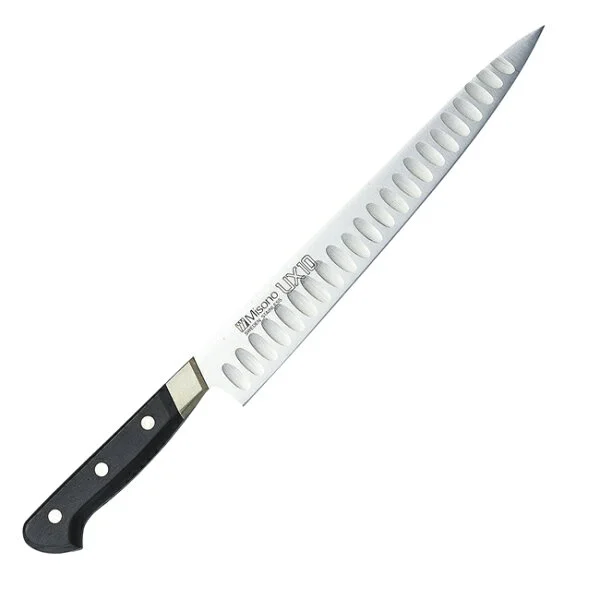
Sujihiki geometry. Long and narrow. The 270mm version I own is about 30mm tall at the heel and tapers to a fine tip. Very thin behind the edge — often under 2mm at the spine, dropping to nearly zero at the apex. This is the opposite of a boning knife. It’s built for one motion: a long, single-stroke pull that releases a clean slice. Any twisting or prying will damage it.
Western boning knife (stiff). Short (15cm/6 inch is common), narrow, with a curved or straight edge. Stout enough to lever through cartilage. Western steel (X50CrMoV15 or similar) at HRC 56–58 — softer than Japanese, more forgiving of abuse.
Western boning knife (flex). Same length, but ground much thinner so the blade flexes 30–60 degrees under pressure. This flex is the entire point — it lets the blade follow the contour of bone or skin. Used for fish filleting and delicate poultry work.
The takeaway: rigid Japanese honesuki vs flexible Western fillet/boning is a real divide. Some butchers prefer rigidity for control; others prefer flex for hugging bone. Different schools, both valid.
What Each Knife Excels At
Honesuki excels at:
- Whole chicken/duck breakdown — the rigidity gives precision around the breastbone
- Removing thigh-leg joints by pivoting through the ball joint
- Scraping clean ribs and breastbone (the heel does this beautifully)
- Trimming fat and silver skin from chicken breasts
- Small game — rabbits, quail, pheasant
Honesuki is bad at:
- Beef or pork primals (too short, no flex)
- Filleting fish (rigidity = wrong tool)
- General prep — onions, vegetables (too thick, weird angle)
Sujihiki excels at:
- Slicing brisket against the grain
- Carving prime rib at the table
- Portioning salmon or tuna loins (raw or cooked)
- Slicing roasted pork shoulder
- Long fish like sashimi-grade salmon (though a yanagiba is more traditional — see yanagiba vs sujihiki)
Sujihiki is bad at:
- Anything bone-adjacent — it’ll chip
- Deep cuts requiring leverage
- General prep — too long and thin for vegetable work
Western flex boning excels at:
- Filleting whole fish (sea bass, snapper, salmon)
- Following the contour of beef/pork bones
- Deboning chicken thighs precisely
- Removing skin from fish
Western flex boning is bad at:
- Heavy joint work (the flex becomes a liability)
- Cleanup cuts that need a stiff tip
Western stiff boning excels at:
- Beef and pork primals — separating muscle groups
- Working through cartilage and ligaments
- Trimming silver skin in volume
Western stiff boning is bad at:
- Delicate fish work (no flex)
- Precision joint articulation in poultry (a honesuki is better)
Learning Curve
This matters because all three of these knives have technique requirements.
Honesuki has the steepest curve. The single-bevel versions especially require you to understand which side of the bevel you’re on for each cut. The grip is different from a chef knife — pinch grip with the forefinger on the spine, using the heel as a fulcrum. Beginners often try to use a honesuki like a tiny chef knife, slicing forward, and they’re disappointed. The honesuki wants pivot motions, scrape motions, and tip work — not push-pull slicing.
Sujihiki is the easiest of the three to learn but the easiest to damage. The motion is just one long pull stroke, full blade length, no sawing. If you saw, you’ll wreck the edge. If you twist, you’ll wreck the blade. As long as you only do clean pulls on cooked meat or fish away from bones, it’s almost foolproof.
Western boning is the workhorse of butcher schools. The technique is documented in countless YouTube videos and butchery textbooks. Stiff is easier to start with; flex requires you to feel the bone through the blade.
Top Picks for Each
Honesuki
Tojiro DP Honesuki 150mm (~$95). VG-10 core, double-bevel, plastic handle. The Tojiro DP line punches above its price across every category and the honesuki is no exception. Sharp out of the box, decent edge retention, easy to sharpen. My go-to recommendation for a first honesuki.
Mac Original Honesuki (~$130). Lighter, very thin grind, extremely sharp. Mac’s stainless is softer than VG-10 so you’ll touch up more often, but the sharpness is excellent. Beloved by Western butchers who prefer lighter knives.
Misono UX10 Honesuki (~$220). Premium swedish stainless steel, thinner and harder than the Mac, beautifully balanced. Probably the best honesuki I’ve used, but at the price you should be sure you’ll use it weekly.
Sujihiki
Misono UX10 Sujihiki 270mm (~$310). The benchmark Western-style sujihiki. Swedish stainless, polished finish, factory edge is excellent. The blade is rigid, thin, and balanced. If you carve roasts often, this is the one.
Tojiro DP Sujihiki 270mm (~$130). Half the price, 80% of the performance. VG-10 core, plastic handle, very thin grind. My most-used sujihiki.
Takamura R2 Sujihiki 270mm (~$280). For those who want premium powdered steel and lightning sharpness. R2 holds an edge longer than VG-10 but is harder to touch up freehand.
Western Boning
Wusthof Classic 6-inch Boning (~$150). Stiff, German-style, full tang, the textbook butcher’s knife. Holds up to abuse.
Victorinox Fibrox 6-inch Flex Boning (~$35). The pro fish-filleter’s secret. Cheap, easy to sanitize, factory edge is plenty sharp. Replace every couple of years rather than baby it.
Forschner/Victorinox Stiff Boning (~$35). Same value proposition as the flex but for general butchery.
Comparison Table
| Feature | Honesuki | Sujihiki | Western Boning (Flex) | Western Boning (Stiff) |
|---|---|---|---|---|
| Length | 130–150mm | 240–300mm | 150–180mm | 150–180mm |
| Blade flex | Rigid | Rigid | Very flexible | Rigid |
| Edge angle | 12–15° (single) or 15° (double) | 15° per side | 20° per side | 20° per side |
| HRC hardness | 60–62 | 60–62 | 56–58 | 56–58 |
| Primary task | Poultry breakdown | Slicing cooked/raw meat | Fish filleting | Beef/pork butchery |
| Beginner friendly | Moderate | Easy | Moderate | Easy |
| Price (good quality) | $95–250 | $130–350 | $35–80 | $35–150 |
| Sharpening difficulty | Moderate (single-bevel: hard) | Moderate | Easy | Easy |
| Bone contact OK? | Yes | No | Light only | Yes |
Sharpening Notes
These three knives are sharpened differently.
Honesuki: If single-bevel, you only sharpen the front side and deburr the flat back on a finishing stone. This is a learned skill — see a yanagiba sharpening tutorial for the same technique. Double-bevel honesuki sharpen like any Japanese double-bevel: 15-degree per side, full progression.
Sujihiki: Treat like a long gyuto. Standard 15-degree per side, full progression on a three-stone setup. The thin blade is unforgiving — light pressure only, never camp on a coarse stone.
Western boning: 20-degree bevels, softer steel responds well to a #1000 finish followed by a steel/honing rod. Don’t bother with high-grit polishing — these knives are working tools.
If you don’t already understand the steel side, the Japanese knife steel guide is worth reading first.
Honest Downsides
I want to be transparent about each.
Honesuki downside: Limited use case. If you don’t break down whole birds at least monthly, this knife will sit in the drawer. I genuinely use mine maybe 12 times a year. For most home cooks, a chef knife or boning knife handles the same tasks adequately.
Sujihiki downside: It’s a luxury knife. If you don’t carve large roasts, prime rib, brisket, or whole fish portions, you don’t need a 270mm slicer. A gyuto slices a chicken breast just fine.
Western boning downside: The handles get gross. Plastic handles trap fish blood and chicken juice in the bolster gap. Sanitize aggressively. Also, soft Western steel dulls fast — but it’s also stupidly easy to resharpen, so it’s a wash.
Which One Belongs in Your Kitchen?
You need a honesuki if: you break down whole chickens or game birds regularly, you enjoy the precision of joint work, you care about Japanese-style butchery technique, or you do this for income.
You need a sujihiki if: you cook large roasts (brisket, prime rib, pork shoulder), you serve sashimi or sliced raw fish, you carve at the table, or you want the slicing experience to be a ritual rather than a chore.
You need a Western flex boning knife if: you fillet fish, even occasionally. It’s $35 and indispensable. There is no Japanese substitute that flexes like this.
You need a Western stiff boning knife if: you process beef/pork primals from a CSA or hunt, butcher whole animals, or trim large quantities of meat for jerky/sausage.
You probably don’t need any of these if: you mostly cook vegetables and pre-trimmed proteins. A 210mm gyuto and a paring knife handle 95% of home cooking. Don’t buy specialty knives until you’ve felt the gap.
FAQ
Q: Can a sujihiki replace a yanagiba for sushi? For Western-style cooking, yes. For traditional sushi, no. The single-bevel yanagiba produces a different cut surface that traditional chefs value. See the sushi knife guide.
Q: Can a honesuki replace a deba? No. A deba is a heavy, thick-spined fish-breakdown knife designed to chop through fish heads and spines. A honesuki is too short and thin for that. They overlap only in poultry where a deba is overkill.
Q: Is a gyuto enough? Do I really need any of these? Honestly, for most home cooks: a gyuto + paring + bread knife is enough. See Japanese knife buying guide and best Japanese knives for beginners 2026 for sane starter sets.
Q: Honesuki or garasuki — what’s the difference? Garasuki is a larger, heavier honesuki for ducks and turkeys. Same shape, scaled up to ~180mm. If you process big birds (Thanksgiving turkeys, ducks), garasuki gives more leverage.
Q: Can I use a sujihiki on hot meat right out of the oven? Yes — that’s exactly what it’s for. The thin blade glides through cooked meat without compressing it. Just don’t hit the cutting board hard.
Q: How does a santoku compare to these? A santoku is a general all-purpose knife — see gyuto vs santoku. It doesn’t compete with these specialty knives; it’s a different category.
Q: Will a Japanese honesuki chip on chicken bones? The thigh-leg joint is fine, the breastbone is fine. Spinal column or rib chopping will chip a honesuki. Use a Western cleaver or kitchen shears for hard bone work.
Q: I’m left-handed — is single-bevel honesuki a problem? Yes. Single-bevel knives are handed. Buy a left-hand version (Misono and a few others make them) or buy a double-bevel honesuki, which works for both hands.
Closing Thoughts
After my chicken-breakdown experiment, here’s what I came away with: the honesuki was clearly the most precise on the joints and the breastbone. The Western flex was the most forgiving when I was unsure. The sujihiki had no business in that exercise — but it sliced the cooked breast like a dream once the bird was roasted.
These are three knives for three different stories. Don’t buy all three at once. Identify which task in your cooking life is currently fighting your gyuto, and add the specialty knife that fixes it. That’s the only honest path through this category.
🔪 この記事で紹介した包丁