Guide
Best Nakiri Knives 2026: The Vegetable Specialist Worth Owning
Published: 2026-04-29 · Updated: 2026-04-29
A nakiri is the knife I tell people to buy when they roll their eyes at the idea of a fourth Japanese knife. It’s also the one they end up using most often. Mine sits on the magnetic strip closest to my cutting board, and on a typical weeknight it sees more action than my gyuto.
If you cook vegetables — and that’s most of us — there’s a strong case for owning one. This guide walks through what makes a nakiri different from a santoku or gyuto for vegetable work, the picks I’d actually buy at $50, $100, and $200, and the honest downsides nobody mentions.
What is a nakiri?
A nakiri (菜切り — literally “vegetable cutter”) is a Japanese double-bevel kitchen knife with a tall, rectangular blade. The defining features:
- Profile: flat or near-flat edge, no rocker curve, square or slightly rounded tip
- Height: 45–55mm — significantly taller than most gyuto or santoku
- Length: typically 160–180mm, with 165mm being the most common
- Bevel: double-beveled (V-edge) — sharpens like any Western or modern Japanese knife
- Weight: light to medium, usually 130–180g
- Origin: developed in Japanese home kitchens centuries ago for vegetable prep
There’s also an usuba, which is the single-bevel professional cousin used in Japanese restaurant kitchens for katsuramuki (paper-thin daikon scrolls) and similar finesse work. Usuba are not for home cooks — they’re harder, expensive, and demand skills most of us will never need. When people say “nakiri” they almost always mean the double-bevel home version, and that’s what this guide covers.
Why a vegetable-specific knife at all?
Two reasons, and they’re both about geometry.
Tall blade clears the cuts. When you’re dicing an onion or slicing carrots into a pile, a tall blade pushes everything off the edge as you work. With a 40mm-tall santoku, you’re hitting your knuckles on the cut pieces every few strokes. With a 50mm nakiri, the food just falls away. Sounds minor; it isn’t. Try chopping a head of cabbage with a tall blade and a short blade back-to-back — the difference is real.
Push-cut motion fits a flat profile. A nakiri’s flat edge sits fully against the board with each stroke. There’s no rocking required. Your motion becomes a clean down-and-forward push, which is the most efficient way to dice vegetables once you get the rhythm. Gyuto and santoku have curved edges that want to rock; nakiri doesn’t.
It’s not that you can’t do vegetables with other knives. You can. It’s that a nakiri does this one thing better than anything else, and vegetables are 60–70% of most home prep.
Nakiri vs santoku vs gyuto for vegetables
This is the comparison that actually matters when you’re deciding whether to buy one.
| Nakiri | Santoku | Gyuto | |
|---|---|---|---|
| Blade height | 50mm | 42mm | 38mm |
| Profile | Flat | Slight curve | Curved |
| Tip shape | Square / no point | Sheepfoot | Sharp point |
| Cutting motion | Push cut | Mostly push | Rock and push |
| Veg performance | Best | Good | Decent |
| Meat performance | Limited | Decent | Best |
| Versatility | Low | High | Highest |
| Best length | 165mm | 170mm | 210mm |
| Counter space needed | Less | Less | More |
Nakiri wins on vegetables. Loses on meat (no tip means you can’t really pierce, slice steak, or do delicate work).
Santoku is the compromise. It does vegetables well enough and meat well enough. It’s why every Japanese home has one. If you want one knife for everything, santoku is probably your answer over gyuto.
Gyuto is the most versatile. Best on meat, capable on vegetables, but the shorter blade height and rocking motion make it slower for big veg-prep sessions.
The honest answer for most home cooks who already own a chef’s knife: a nakiri as a second knife is a much bigger upgrade than a slightly nicer santoku or gyuto. It opens up a different way of working.
How a nakiri changes your prep workflow
When I switched to using a nakiri for vegetable prep, three things changed:
-
I stopped pre-sorting cuts. Instead of dicing onion → moving it aside → starting carrots, I just keep going on the same area of the board. The tall blade pushes the previous cuts away as I work.
-
My knuckles stopped hurting. Long sessions of julienning or fine-dicing on a short blade lead to that low-grade ache from board contact and tight knuckles. The taller blade gives clearance.
-
I got faster at uniform dicing. The flat profile means every stroke contacts the board the same way. Once you find the rhythm, your dice gets more consistent.
It’s the kind of thing you don’t notice you wanted until you have it.
Best nakiri at every budget
I limit picks to knives I’ve owned, used, or have strong direct evidence on from people I trust.
Best under $50: Tojiro F-300 Nakiri 165mm (~$45)
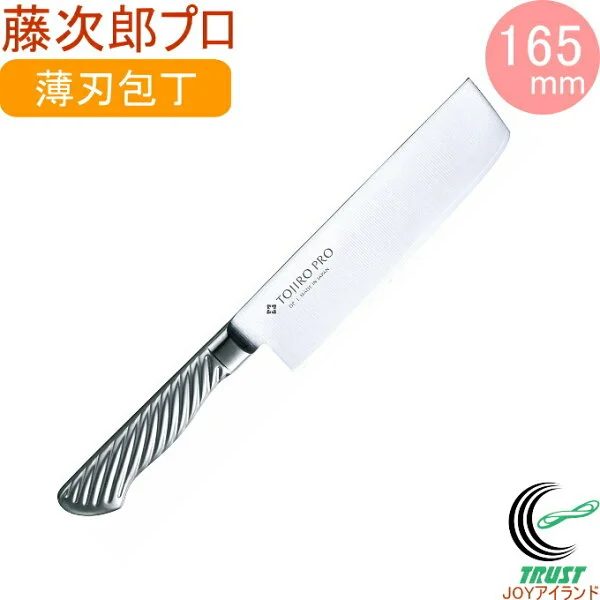
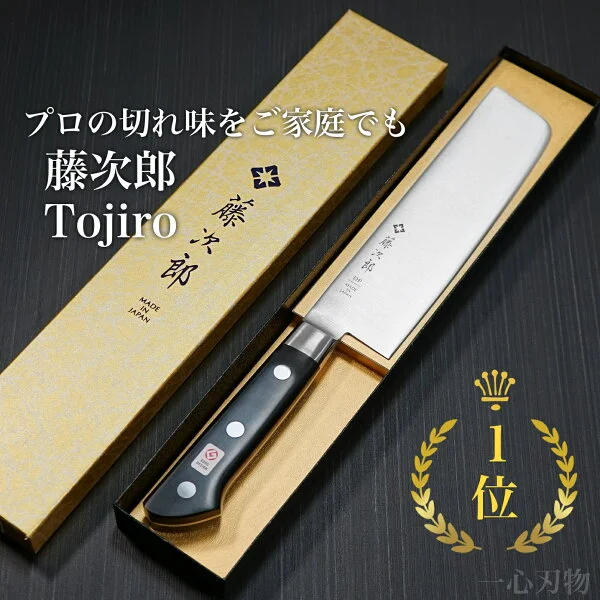
Stainless basic-bin nakiri, full tang, plastic handle. Edge isn’t as fine as the DP series but for $45 it’s a remarkable amount of knife. If you’re not sure you’ll like a nakiri, buy this one. If you don’t reach for it, you’ve spent less than dinner. If you do reach for it, you’ll know what to upgrade to.
Best under $100: Tojiro DP Nakiri 165mm (~$95)
This is my standing recommendation when anyone asks for a “first nice nakiri.” Tojiro DP 165mm is VG-10 stainless clad in soft stainless, Western handle, and it punches well above its price. Great edge retention, easy to sharpen, no rust worries. I’ve bought this one for three different people as a gift and they all still use it.
It also fits perfectly with the rest of my under-$100 picks for someone building a Japanese knife kit on a budget.
Best under $200: Sakai Takayuki Ginsan Nakiri 165mm (~$160)
Ginsan (silver-3) stainless, Sakai-made, traditional Japanese octagonal handle. This is a meaningful step up from the Tojiro — the steel takes a finer edge, holds it longer, and the construction quality is closer to a $300 knife than a $100 one. Sakai Takayuki has been my go-to brand for “more than entry-level but not crazy” for years.
If you want carbon instead of stainless at this price, the Tojiro Shirogami nakiri (white #2 carbon) is around $130 and gets a sharper edge but requires drying after every use.
Best under $300: Yu Kurosaki Senko or Masakage Yuki Nakiri (~$240–$280)
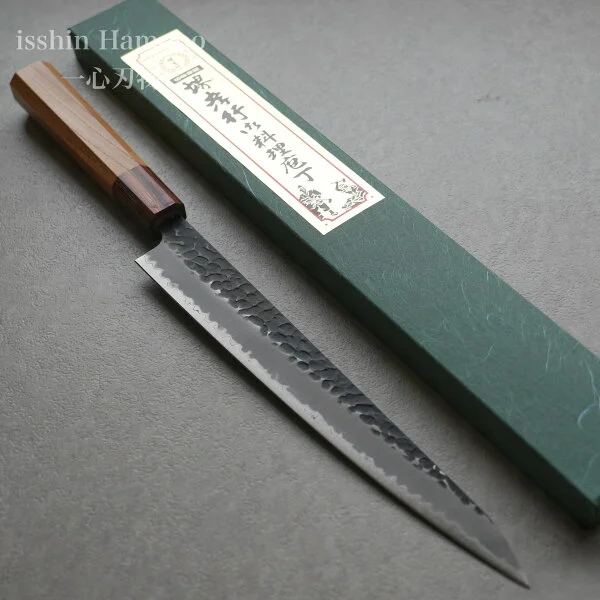
At this level you’re paying for hand-finished blades, usually with a kurouchi (rough black) or nashiji (pear-skin) finish, and premium steels like Aogami Super or SG2. They’re knives that look as good as they cut. The Masakage Yuki has a beautiful kasumi finish, white #2 core, and it’s the nakiri I’d buy myself if I were replacing my current daily.
Best over $300
Honestly? Diminishing returns. A $400 nakiri doesn’t dice an onion meaningfully better than a $200 one. If you’re spending more here, it’s because you specifically want a maker’s craftsmanship — Yoshimi Kato, Hatsukokoro, Hado, or similar — and that’s a fine reason. Just be honest with yourself that it’s an aesthetics-and-soul purchase, not a performance one.
Steel choice for nakiri
Nakiri spend most of their life on board work, hitting cutting boards thousands of times per session. Edge retention matters a lot.
-
Stainless cores (VG-10, Ginsan, SG2/R2) — my recommendation for a daily-use nakiri unless you specifically want carbon. The acid in onions, tomatoes, citrus, and pickles will corrode carbon steel quickly if you don’t dry between cuts. With stainless, you can lay down the knife and come back to it.
-
Carbon (white #2, blue #2, Aogami Super) — sharper, holds edge longer in pure cutting terms, develops gorgeous patina. But you’ll be wiping the blade every few cuts, and storage is fussier.
For most home cooks, stainless wins for nakiri specifically. The vegetable-acid problem is real and constant. My full breakdown is in the steel guide if you want to go deeper.
Maintenance
A nakiri is one of the easier Japanese knives to maintain because you’re rarely cutting through bone, frozen food, or anything that abuses the edge. Basics:
-
Wash by hand, dry immediately. No dishwasher ever. This applies to all Japanese knives but doubly to nakiri because the tall blade has more surface area to corrode.
-
Use a soft cutting board. Wood (hinoki, maple, walnut) or end-grain bamboo. Never glass, never granite, never countertop tile. The flat profile means the edge contacts the board on every cut, so a hard board destroys the edge fast.
-
Hone weekly, sharpen as needed. A nakiri probably needs full sharpening every 3–4 months for a daily home cook. Less if you only veg-prep on weekends.
-
Steel: skip the rod. Steel honing rods are fine for German knives. For Japanese steel, use a ceramic rod or a high-grit finishing stone (#5000–#8000) for quick touch-ups.
For a deeper dive into the things that wreck Japanese knives, my common mistakes guide is worth reading once. Most of the failures I see are preventable.
When NOT to buy a nakiri
I’ll be the contrarian here. A nakiri isn’t for everyone.
Skip it if you don’t have a chef’s knife yet. Your first Japanese knife should be a gyuto or santoku — something general-purpose. Nakiri is a specialist; specialists come second. My first knife guide covers this in detail.
Skip it if you mostly cook meat. If 70% of what you cook is steaks, chops, roasts, and BBQ, a nakiri will gather dust. Get a sujihiki or another gyuto.
Skip it if you only cook 1–2 nights a week. The benefit of a nakiri compounds over volume. If you’re making three salads a week, a sharp santoku covers you fine.
Skip it if you have very limited drawer/storage space. Nakiri tend to live on magnetic strips because their tall profile doesn’t fit standard knife rolls or blocks. Plan for it.
Honest downsides nobody mentions
Things I’ve come to dislike or notice over years of nakiri use:
-
No tip means no piercing. Coring a tomato? Annoying. Trimming a strawberry? Awkward. You’ll want a paring knife alongside.
-
Push-cut technique has a learning curve. If you’ve been rocking a chef’s knife your whole life, the flat profile feels weird at first. Two weeks of regular use and it clicks, but plan for the adjustment.
-
The square tip can chip. I dropped my first nakiri tip-down onto a tile floor (don’t ask) and had to grind 3mm off the corner. Not a fault of the knife, but the geometry is less forgiving than a curved tip.
-
Limited resale market vs gyuto. If you decide nakiri isn’t your style, used nakiri don’t move as fast as gyuto on the resale market. Less universal demand.
-
It can encourage knife collection. Once you own a nakiri and a gyuto, you start eyeing a sujihiki, a petty, a deba… speaking from experience.
FAQ
Is a nakiri the same as an usuba? No. Nakiri is double-bevel for home use. Usuba is single-bevel for professional use, harder to learn and sharpen, used for traditional Japanese cuts like katsuramuki. Don’t buy an usuba unless you specifically know why you want one.
What size nakiri should I buy? 165mm for almost everyone. 170–180mm if you have a large board and big hands. Below 160mm gets too short to be worth owning.
Can a nakiri replace my chef’s knife? For pure vegetable cooking, almost. For mixed cooking (meat + veg), no — you’ll miss the tip and the rocker. It’s a complement, not a replacement.
Is nakiri good for beginners? The push-cut motion is actually easier to learn than rocking a chef’s knife. Many beginners pick it up faster. It’s the bevel-grinding angles for sharpening that take time, but that applies to any first Japanese knife.
How is a nakiri different from a Chinese cleaver? Chinese cleavers (cai dao) are even taller and longer, often heavier, and intended as a do-everything kitchen knife. Nakiri is shorter, lighter, narrower in scope. They share the tall-blade advantage for clearing cuts, but a nakiri feels much more nimble.
Can I use a nakiri on meat? For boneless meat trimming, sure. For slicing steak or breaking down chicken, no. The flat profile and lack of tip are limitations.
Will I ruin a nakiri on a glass cutting board? Yes, fast. The flat profile means every cut hits the board with the full edge. On glass or stone, you’ll roll or chip the edge within weeks. Use wood or soft plastic only.
Is a nakiri a good gift for someone learning to cook? Yes, if they already own a chef’s knife. As a first knife, it’s too specialized. As a second knife or a “next step” gift, it’s outstanding because it teaches a different cutting motion and they’ll feel the upgrade immediately.
What I’d buy today
If I were starting from scratch with a $200 budget for a nakiri, I’d spend $160 on the Sakai Takayuki Ginsan 165mm and put the other $40 toward a finishing whetstone. That’s a knife that’ll last 15+ years, sharpens beautifully, and produces cuts that make you actually want to cook.
If I had $100, Tojiro DP 165mm. Done. No second guessing.
If I had $50 and was just dipping a toe in, the Tojiro F-300. Get the cheap one, see if you love the format, upgrade later.
Beyond specific picks, the broader Japanese knife buying guide is a good reference if you’re still mapping out the whole kit you eventually want.
The format itself — that tall, flat, light blade — is the thing worth investing in. Once you’ve used a nakiri for a few weeks, the idea of dicing onions on anything else starts to feel slow. That’s the test. If you cook vegetables more than once or twice a week, a nakiri earns its drawer space the first month and never gives it back.
🔪 この記事で紹介した包丁